The process of painting:Did Rembrandt hit a”Procrastination phase”?

I don’t think so. By most accounts Rembrandt was a pretty effective artist in a time when there wasn’t much room for frivolities. A painting, mostly a portrait was commissioned and the artist was supposed to deliver the goods as ordered. It’s us modern artists who can fret and doodle as our whims dictate.
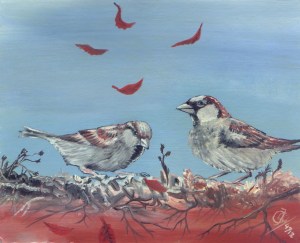
Sometimes I use the "Phase" to make a small one.

I can use the "Phase" to make a small painting.

Sometimes at the first stages of setting up a painting I will hit some kind of barrier.  I’ll have to decide where certain parts of the composition need to go or where the light needs to come from.  I can sit staring at the canvas for a long time and nothing happens. Well not on the canvas, but the thoughts race through my mind. It will take a while and sometimes it feels like a mild form of stress and I feel guilty for not being able to work effectively. Sometimes I decide it’s better to do something completely different like fixing a car or to go for  a long walk.  Maybe even writing for this weblog. I call this the “procrastination phase” . Only later I realise this phase is an important moment:  I set  the design while I “procrastinate”.  It’s an essential part of my painting process. It’s not procrastination at all! It just looks much like it.

Wikipedia says:

Procrastination is a type of behavior which is characterized by deferment of actions or tasks to a later time. Psychologists often cite procrastination as a mechanism for coping with the anxiety associated with starting or completing any task or decision. [1] Psychology researchers also have three criteria they use to categorize procrastination. For a behavior to be classified as procrastination, it must be counterproductive, needless, and delaying.[2]

For an individual, procrastination may result in stress, a sense of guilt, the loss of personal productivity, the creation of crisis and the disapproval of others for not fulfilling one’s responsibilities or commitments. These combined feelings can promote further procrastination. While it is normal for people to procrastinate to some degree, it becomes a problem when it impedes normal functioning. Chronic procrastination may be a sign of an underlying psychological or physiological disorder.

The process of painting. Was Pablo Picasso wrong?

A quote by Pablo Picasso : “There are painters who transform the sun to a yellow spot, but there are others who with the help of their art and their intelligence, transform a yellow spot into the sun.”

So there it is: One of the essential things a painter wants(needs) to achieve: transform a yellow spot into the sun, a blob of paint into a highlight, a set of lines into perspective, smears of blue and white into a dramatic sky. It sounds easy enough and sometimes it even is. But quite often the road to change that spot or line into the building block of your artwork is more of an anxious struggle.

I know, I do it all the time and I’m not often sure of the result until a spectator cries in horror or exclaims praise. The joy of finishing a painting is something I can’t explain. It’s there until I realize that now this project has finished there’s a new challenge coming. I need to start a new painting! I feel really lucky when the notion of a composition has come before I start painting. Sometimes this is followed by a frantic phase to record the composition and it’s basic building blocks on the canvas before I forget or kill it by a new train of thought. After that I can blissfully continue until I hit a snag that I haven’t anticipated. That is, for instance how to transform a specific spot of colour into the object I had envisioned in my compositional dreams.

There used to be a time I could just sit down and the picture would swim in place on my canvas and I would paint through the night to get rid of this torrent of creativity. To be honest these pictures didn’t appeal to many people and after a while they even bothered me, so the stream of feverish dreams stopped to be admitted to canvas. I had thought becoming a painter would be an inevitable destiny, but I just didn’t want to paint the way I had done and I couldn’t see another. So I didn’t paint much for quite some years and went away from art to pursue a business career. That went well and I enjoyed it a lot. Suddenly I found another urge to paint, I saw that I could spend my days painting and it was the right thing to do. And while I did this I found my mind had calmed in such a way that there were no torrents of feverish dreams to paint anymore but dreams I could translate in fantasies. It’s not all easy though. As I said before. And I think old Pablo is right. The hardest thing is to transform that spot into your dream.

Next time: the “procrastination phase”

This "Bibia" is one of the old ones(1978) I do like.

This "Bibia" (1978 )is actually one of the old ones I do like.